Closing the Loop: Achieving Sustainability in Event Waste

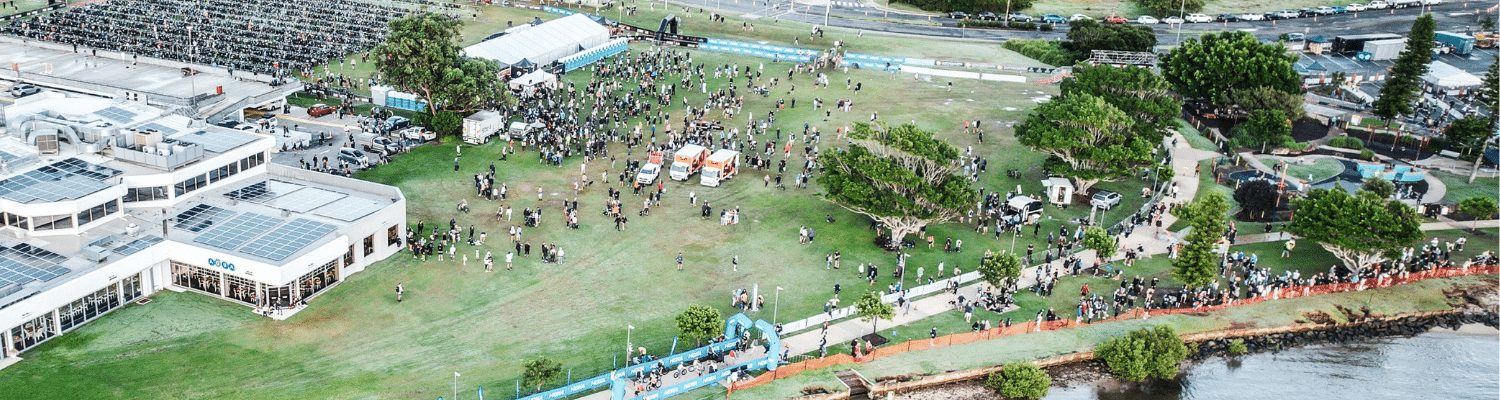
Drone shot of Westport Park as Ironman event begins

In recent years there has been a growing recognition of the need to think and act more sustainably about event management.

From local community activities to large-scale festivals and events, it is encouraging to see our local organisers increasingly prioritising waste reduction, resource conservation, and circular practices 

An example of these efforts can be seen through this year’s IRONMAN Australia and IRONMAN 70.3 Port Macquarie, which saw The IRONMAN Group Oceania join forces with Closed Loop to minimise the environmental impact of the event and increase landfill diversion. Their efforts, in collaboration with event volunteers and a range of local groups and organisations, led to a remarkable landfill diversion rate of 73%, showcasing the positive impact that can be achieved through responsible waste management.  

The event produced a total of 111m3 of waste, across 6 core waste streams: general waste, commingled recycling, paper and cardboard, organic food waste, paper cups, and cans and containers eligible for 10c donation scheme. Let’s take a look at how the Closed Loop team worked with Ironman, volunteers and local businesses and organisations to achieve such a fantastic diversion result.

General Waste, Co-Mingled Recycling, and Paper and Cardboard 

A standard requirement of events held in the Port Macquarie-Hastings region is that additional red general waste and yellow recycling bins are provided for waste generated at the event. This ensures a recycling solution is available for event patrons, permanent public bins aren’t overloaded and litter is minimised. Thirty yellow and red bin sets were deployed by Closed Loop, in addition to several temporary bins placed by Council in the CBD to support increased foot traffic. AUS Blue Bins skips were also utilised by Closed Loop, then sorted after collection into various recycling streams. A total of 15m3 of commingled waste and 42m3 of paper and cardboard were diverted from landfill. 

Organic Food Waste
While often overlooked, food waste is a significant issue at events. When placed in the red bin and sent to landfill, food waste produces methane which is 25 times more potent for the environment than carbon dioxide. Not to mention the missed opportunity to put it to better use. Keen to bring a circular solution to this problem, Closed Loop collected 2m3 of pre-cut bananas, oranges and other fruit otherwise destined for landfill.

This was donated to the Billabong Zoo Koala and Wildlife Park, offering a tasty treat for the park’s animal residents. 

Paper cups 

Disposable paper cups have long posed a waste problem at events. Because of their waterproof lining, paper cups cannot be placed in regular commingled or paper and cardboard recycling systems and therefore usually end up in landfill. Recognising the environmental impact of this waste stream, Closed Loop established a product stewardship initiative in 2017 called Simply Cups, which has, to-date, seen over 35 million cups collected across permanent and temporary collection locations across the country. These are then converted into materials for more sustainable production of everyday products such as roads, building material and lightweight concrete slabs. Thanks to the utilisation of this system by Closed Loop, 1m3 of paper cups were successfully collected at this year’s IRONMAN Australia. 

Container Deposit Scheme Items 

Increasing container recycling at events has been encouraged in recent years thanks to the Return and Earn initiative. Thanks to this scheme, separately collecting eligible return and earn cans and containers not only boosts recyclability but also supports local fundraising endeavours. At this year’s Ironman, Closed Loop worked with volunteers from the Koala Hospital to collect a total of 3250 items eligible for the scheme, which were then taken to the Return and Earn depot at Jindalee Rd, Port Macquarie for bulk sorting. In addition to a big waste diversion win, this collection resulted in a $325 donation towards Koala Conservation within the region.  

Celebrating the Success 

The collaboration between Ironman Australia, Closed Loop, volunteers, and local businesses and organisations is one of many local examples of the power of community working together towards more sustainable events. By implementing innovative solutions like product stewardship initiatives, container deposit schemes, and strategic waste management practices, we can pave the way for a greener and more sustainable future for events in our community. 

Share your Story or Celebrate Another’s

Are you a part of, or know, a local event group also working hard towards sustainable event management? We invite you to contribute to the conversation by sharing your stories or impact reports with us so that we can collectively celebrate the efforts!  

With continued dedication and awareness, we can build upon these success stories and inspire others to follow suit, fostering a culture of sustainability and responsible waste management, making our community events even more enjoyable and meaningful. 
Related posts

Koalas may be an Australian icon, but they are also endangered – and as breeding season begins, they’ll be moving more often through our neighbourhoods, roads and bushland. Conservation Status...

At first glance Giant Parramatta Grass and Giant Rat’s Tail Grass can look like just another clump of grass in the paddock – but they can quickly take over. Invasive...

Council’s 2026 Annual Tree Planting Program has successfully wrapped up, with ninety-two advanced trees planted across the region this season. Following a dry spring and summer, the arrival of autumn...

More than 50 community volunteers joined Port Macquarie Hastings Council and Hastings Landcare at Bunderra Reserve, Beechwood, on Sunday 27 July to celebrate National Tree Day. Volunteers of all ages...

Closing the Loop: Achieving Sustainability in Event Waste

Drone shot of Westport Park as Ironman event begins

In recent years there has been a growing recognition of the need to think and act more sustainably about event management.

From local community activities to large-scale festivals and events, it is encouraging to see our local organisers increasingly prioritising waste reduction, resource conservation, and circular practices 

An example of these efforts can be seen through this year’s IRONMAN Australia and IRONMAN 70.3 Port Macquarie, which saw The IRONMAN Group Oceania join forces with Closed Loop to minimise the environmental impact of the event and increase landfill diversion. Their efforts, in collaboration with event volunteers and a range of local groups and organisations, led to a remarkable landfill diversion rate of 73%, showcasing the positive impact that can be achieved through responsible waste management.  

The event produced a total of 111m3 of waste, across 6 core waste streams: general waste, commingled recycling, paper and cardboard, organic food waste, paper cups, and cans and containers eligible for 10c donation scheme. Let’s take a look at how the Closed Loop team worked with Ironman, volunteers and local businesses and organisations to achieve such a fantastic diversion result.

General Waste, Co-Mingled Recycling, and Paper and Cardboard 

A standard requirement of events held in the Port Macquarie-Hastings region is that additional red general waste and yellow recycling bins are provided for waste generated at the event. This ensures a recycling solution is available for event patrons, permanent public bins aren’t overloaded and litter is minimised. Thirty yellow and red bin sets were deployed by Closed Loop, in addition to several temporary bins placed by Council in the CBD to support increased foot traffic. AUS Blue Bins skips were also utilised by Closed Loop, then sorted after collection into various recycling streams. A total of 15m3 of commingled waste and 42m3 of paper and cardboard were diverted from landfill. 

Organic Food Waste
While often overlooked, food waste is a significant issue at events. When placed in the red bin and sent to landfill, food waste produces methane which is 25 times more potent for the environment than carbon dioxide. Not to mention the missed opportunity to put it to better use. Keen to bring a circular solution to this problem, Closed Loop collected 2m3 of pre-cut bananas, oranges and other fruit otherwise destined for landfill.

This was donated to the Billabong Zoo Koala and Wildlife Park, offering a tasty treat for the park’s animal residents. 

Paper cups 

Disposable paper cups have long posed a waste problem at events. Because of their waterproof lining, paper cups cannot be placed in regular commingled or paper and cardboard recycling systems and therefore usually end up in landfill. Recognising the environmental impact of this waste stream, Closed Loop established a product stewardship initiative in 2017 called Simply Cups, which has, to-date, seen over 35 million cups collected across permanent and temporary collection locations across the country. These are then converted into materials for more sustainable production of everyday products such as roads, building material and lightweight concrete slabs. Thanks to the utilisation of this system by Closed Loop, 1m3 of paper cups were successfully collected at this year’s IRONMAN Australia. 

Container Deposit Scheme Items 

Increasing container recycling at events has been encouraged in recent years thanks to the Return and Earn initiative. Thanks to this scheme, separately collecting eligible return and earn cans and containers not only boosts recyclability but also supports local fundraising endeavours. At this year’s Ironman, Closed Loop worked with volunteers from the Koala Hospital to collect a total of 3250 items eligible for the scheme, which were then taken to the Return and Earn depot at Jindalee Rd, Port Macquarie for bulk sorting. In addition to a big waste diversion win, this collection resulted in a $325 donation towards Koala Conservation within the region.  

Celebrating the Success 

The collaboration between Ironman Australia, Closed Loop, volunteers, and local businesses and organisations is one of many local examples of the power of community working together towards more sustainable events. By implementing innovative solutions like product stewardship initiatives, container deposit schemes, and strategic waste management practices, we can pave the way for a greener and more sustainable future for events in our community. 

Share your Story or Celebrate Another’s

Are you a part of, or know, a local event group also working hard towards sustainable event management? We invite you to contribute to the conversation by sharing your stories or impact reports with us so that we can collectively celebrate the efforts!  

With continued dedication and awareness, we can build upon these success stories and inspire others to follow suit, fostering a culture of sustainability and responsible waste management, making our community events even more enjoyable and meaningful. 
Categories
Related posts

Tricky Waste Item of the Month

Each month, we’re highlighting a tricky waste item that often causes confusion at the bin. Knowing where these items belong helps reduce contamination and keep our waste and recycling systems

'Spot the Sticker' and WIN!

Batteries can spark fires and don’t belong in any of our bins.

To help our community learn how to dispose of them safely we’re giving away a $50 gift card every week for 6 weeks. 

Keep your eyes peeled for our “Don’t Bin Me” battery sticker on local waste trucks and you could score a $50 gift card! Click below to learn more about the competition and how to dispose of batteries safely.

Booking Enquiry Form

Please complete the form below and our education team will touch base soon to discuss your enquiry.

Booking Enquiry Form

Please complete the form below and our education team will touch base soon to discuss your enquiry.