Weed of the Month: Paper Mulberry

This isn’t your typical backyard mulberry tree.

Native to south-east Asia, this fast-growing deciduous tree becomes invasive in tropical and subtropical areas, particularly in sunny gaps on creeks, disturbed forests and farmland.

Paper mulberry spreads rapidly, forming dense stands that shade out native species, reducing food and habitat. It uses vast amounts of water and can block creeks. It can spread rapidly from root suckers, stem fragments or coppicing, and by seed when male and female plants are present. Birds and bats will also eat the fruit and disperse the seeds over larger areas.

Male Paper mulberry trees produce large amounts of pollen and are known to cause significant allergic reactions in areas where infestations have gotten out of hand.

A fast growing tree
Shallow grooves on paper mulberry bark Photographer Alberto Salguero Source: NSW Weedwise

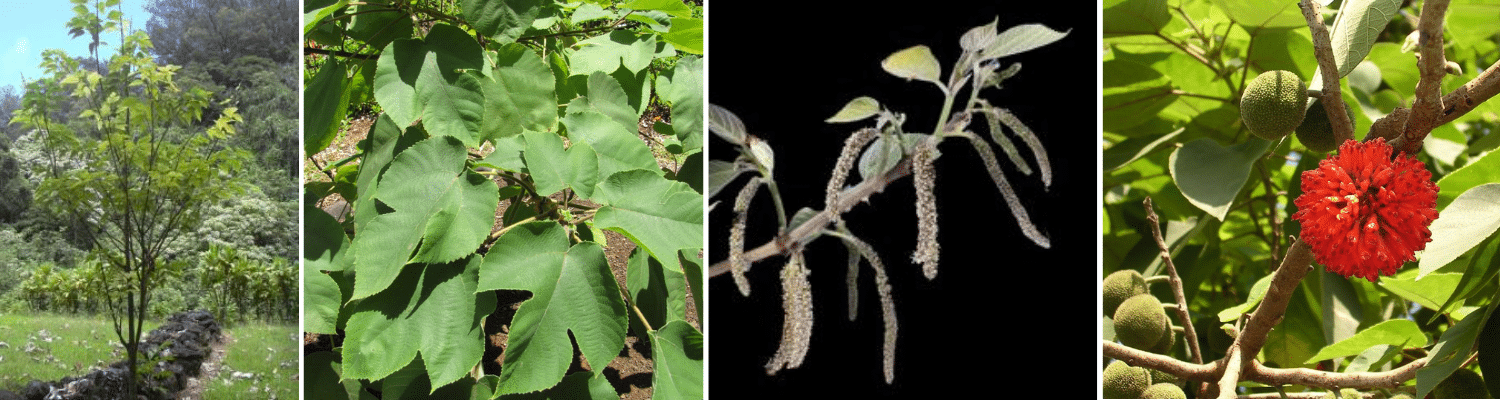
Paper mulberry grows to around 12-20m high, with a large, spreading crown. It has a light-grey, smooth bark, and produces milky sap from cut stems.

Leaves are large and variable, being oval to heart-shaped, sometimes with 3-5 lobes. They are rough on the upper surface and soft below.

There are separate male and female flowers. Male flowers are cream-coloured on small spikes that hang down beneath the branches, whilst female flowers form a cluster like a small green ball to 2.5cm.

The fruit cluster forms an orange-red ball when ripe.

Report this weed to the biosecurity officer

Control can be difficult and any plants must be reported to the Biosecurity officer. Due to Paper mulberry’s ability to re-sprout from the roots, chemical control is often more effective than physical removal. Consult your weeds officer for advice on removal. Further details can be found here: NSW WeedWise
Related posts

Hidden amongst the treetops of our region is a tiny but mighty hunter with a tail like a bottlebrush and a brutal breeding season where the males do not survive...

Biodiversity Month is a great reminder that our region is home to an incredible variety of plants and animals – including some very protective feathered locals.  As spring arrives, so...

Mexican Feather Grass may look like an attractive ornamental grass, but if it escapes from gardens it can become a serious problem for pastures, bushland and roadsides. This highly invasive...

Plum Pine (Podocarpus Elatus) is a distinctive native conifer with unusual fruit and strong links to our local rainforests. In our local bushland, we have only three species of native...

Weed of the Month: Paper Mulberry

This isn’t your typical backyard mulberry tree.

Native to south-east Asia, this fast-growing deciduous tree becomes invasive in tropical and subtropical areas, particularly in sunny gaps on creeks, disturbed forests and farmland.

Paper mulberry spreads rapidly, forming dense stands that shade out native species, reducing food and habitat. It uses vast amounts of water and can block creeks. It can spread rapidly from root suckers, stem fragments or coppicing, and by seed when male and female plants are present. Birds and bats will also eat the fruit and disperse the seeds over larger areas.

Male Paper mulberry trees produce large amounts of pollen and are known to cause significant allergic reactions in areas where infestations have gotten out of hand.

A fast growing tree
Shallow grooves on paper mulberry bark Photographer Alberto Salguero Source: NSW Weedwise

Paper mulberry grows to around 12-20m high, with a large, spreading crown. It has a light-grey, smooth bark, and produces milky sap from cut stems.

Leaves are large and variable, being oval to heart-shaped, sometimes with 3-5 lobes. They are rough on the upper surface and soft below.

There are separate male and female flowers. Male flowers are cream-coloured on small spikes that hang down beneath the branches, whilst female flowers form a cluster like a small green ball to 2.5cm.

The fruit cluster forms an orange-red ball when ripe.

Report this weed to the biosecurity officer

Control can be difficult and any plants must be reported to the Biosecurity officer. Due to Paper mulberry’s ability to re-sprout from the roots, chemical control is often more effective than physical removal. Consult your weeds officer for advice on removal. Further details can be found here: NSW WeedWise
Categories
Related posts

Heads up: Magpie swooping season has arrived

Biodiversity Month is a great reminder that our region is home to an incredible variety of plants and animals – including some very protective feathered locals.  As spring arrives, so

'Spot the Sticker' and WIN!

Batteries can spark fires and don’t belong in any of our bins.

To help our community learn how to dispose of them safely we’re giving away a $50 gift card every week for 6 weeks. 

Keep your eyes peeled for our “Don’t Bin Me” battery sticker on local waste trucks and you could score a $50 gift card! Click below to learn more about the competition and how to dispose of batteries safely.

Booking Enquiry Form

Please complete the form below and our education team will touch base soon to discuss your enquiry.

Booking Enquiry Form

Please complete the form below and our education team will touch base soon to discuss your enquiry.